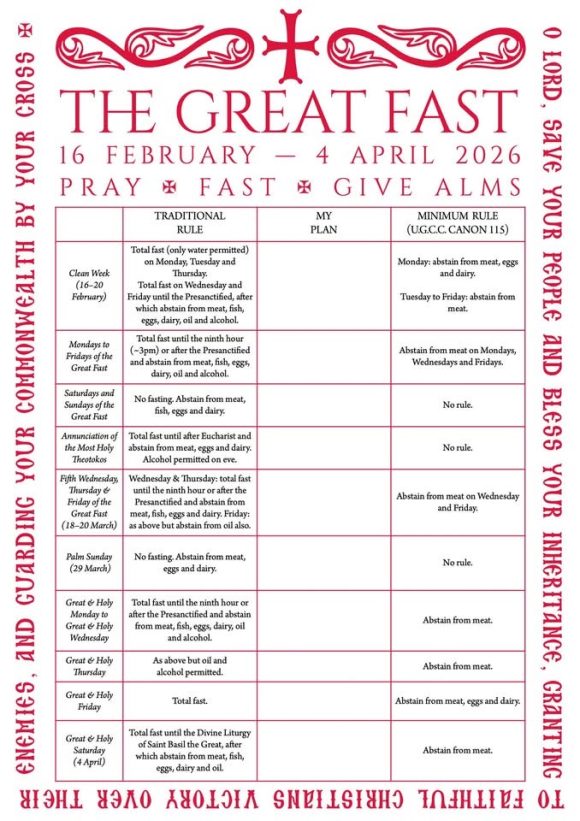
 Each year the onset of the Great Fast raises questions about how one should be fasting and what the Church requires. And, while we should never approach fasting pharisaïcally, it is spiritually profitable to be aware of traditional practice and the minimum required by the Church in order to chart one’s own course according to personal circumstance. To this end, we have produced a chart detailing the traditional fasting rule and the canonical minimum set by the Holy Synod of the Ukrainian Greek Catholic Church with an empty column for one’s own fasting plan. ✠
Tag: Great Fast
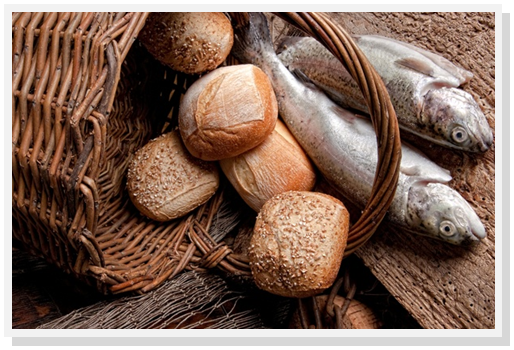
Lent –the Great Fast
Lent begins forty days before Flowery (Palm) Sunday, on the Monday after Forgiveness Sunday (Cheese-Fare Sunday), and lasts until the Friday preceding Palm Sunday.
Holy Week is a special Fast in honor of our Lord’s Passion, and lasts from the evening of Palm Sunday until Holy Saturday inclusive.
Fasting is voluntary. It is an imposed, self-discipline, and expected of all who are physically able. To help us, the Church sets out both the maximal and minimal rules for fasting. Faithful Christians need to take into account their individual circumstances, – health, age, physically, demanding jobs, etc., when making decisions around fasting. With the exception of nursing and expectant mothers, small children, the poor, the mentally or physically, ill or aged, all are required to keep the minimal fast
Penitential fasting practices, repentance and abstinence that aim to expiate the sins committed and to achieve a greater level of perfection for personal sanctity are the oldest tradition in the Ukrainian Greek Catholic Church. (Canon 115 §1 of the Particular Law of the UGCC).
Canon 115 §2 of the Particular Law of the Ukrainian Greek Catholic Church imposes on all faithful the following obligations during the Great Fast:
A strict fast is observed on the first day of the Great Fast and Passion Friday, i.e. abstention from meat and dairy products and eggs as well as foods that contain these ingredients.
Abstention from all meat and foods containing meat is to be observed during the first week of the Great Fast and all days of Passion Week.
During the Great Fast, abstention from the consumption of meat and meat products is to be observed on all Mondays, encouraged on Wednesdays and Fridays. All other foods are permitted on Tuesdays and Thursdays.
6.3 of the same canon enumerates those who are dispensed from any obligation to fast:
children up to 14 years of age; persons over 60 years of age; the gravely ill; pregnant women; postpartum mothers and those who are breastfeeding; those who are travelling (if the travel time exceeds eight hours); those engaged in heavy labour; those who eat from the table of others; the poor who live from charity.
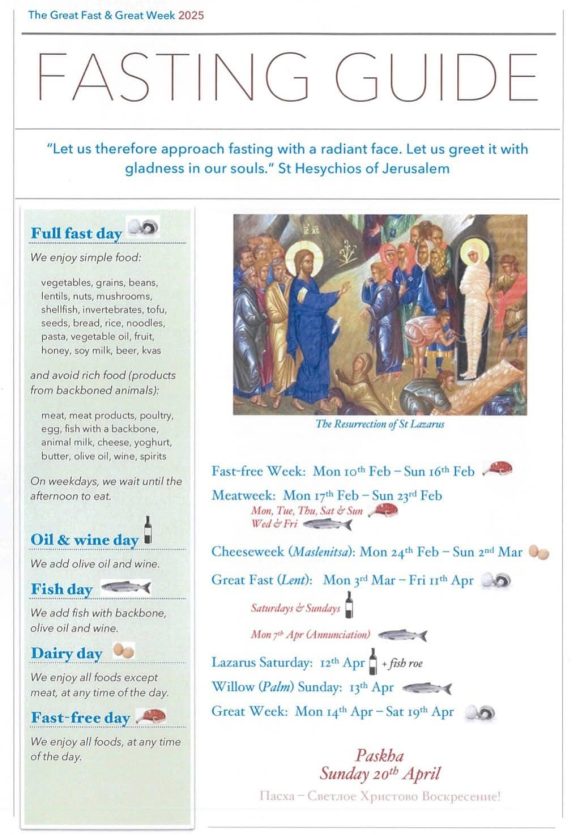
Fasting Guide
The wisdom of the Church is that we fast according to what we are able. Some can follow the Lenten guide well, others due to age or health may not be able to follow the guide –do the best you can do. All can do something. An important note: we do not approach the Fast legalistically.
A good rule of thumb is do as much as you think you can, and then a little bit more (and next year, build on that). Remember that prayer and almsgiving are the other two pillars of Lent, so attend the Liturgy of the Pre-sanctified Gifts (Fridays at 7pm starting on March 14) and whatever other Lenten services are offered; and give generously to those in need. The purpose of fasting is to open ourselves up to the spiritual life, to theosis (divinization), coming closer to life in the Holy Trinity, turning away from sin and living in Grace.
When questions/concerns arise, you ought to prayerfully discern with your spiritual father (e.g., Father Iura) how you will observe the fast this year. If you become fixated on what you are eating, you are doing it wrong.
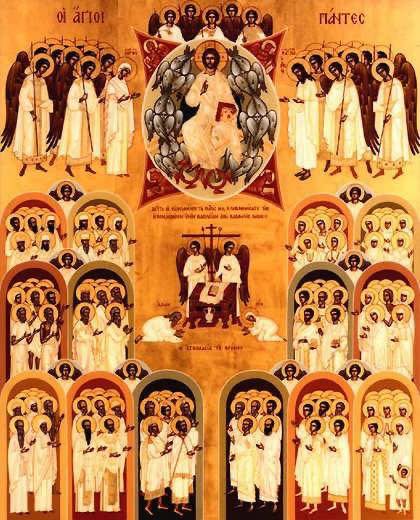
All Souls
There are 5 All Soul’s Saturdays. 2, 3, and 4 were on Saturdays during the Great Fast on days that had no other commemoration (e.g. the Miracle of Theodore and Akathistos). This is due to the liturgical law that fasting periods are more conservative and retain ancient customs. Saturday, the day our Lord was in the tomb was a day for remembering the departed, and that has persisted until the present in Lent.
The All Souls’ Saturday before Meatfare Sunday was due to the Church Year. Meatfare Sunday was the Gospel of the Last Judgment and, in a way, concluded the regular cycle of Gospel beginning with Pascha and lasting until the next Great Fast (beginning with Cheesefare Sunday). It was natural, therefore, to remember the departed as we pray for all before the final and last judgment. The fifth All Souls’ Saturday the day before Pentecost does not have clear origins. Some have said that it is the Christianization of the pagan feast of Rosalia, which remembered virgins who have died a violent death. Their souls were locked in trees and were released on this feast day.
The Christians generalized this into a general feast for all the departed. Some find this controversial, since the ideology is that Christians owe nothing to pagans. We have no concrete evidence one way or the other. It might be connected with All Saints, which in the Byzantine Church was the Sunday after Pentecost, but this does not explain the one week delay. At any rate, though Pentecost is the Christian feast of the 50th day, corresponding directly to the Jewish feast of the Mt. Sinai covenant (note the Upper Room), it was also called Rusalka (in Slavonic) since it happened closely to the pagan feast.
The All Saints feast was originally “All Martyrs,” namely those who died a violent death in witness to Christ. Rome originally celebrated it at the same time as the Byzantines, but moved it to November 1, the Dedication of the Pantheon, the pagan temple made into the Christian Church of the All Saints. In our faith and worship, though, this all has a clearly Christian meaning.
Third Week of the Great Fast
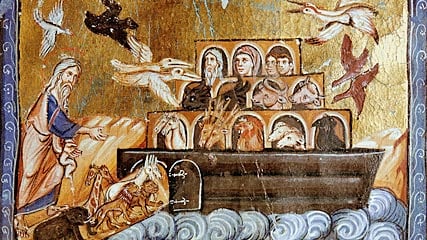
During this week, at Vespers, we read the story of the flood and the salvation of the righteous man Noah and his family. At first, this might seem to be the dark side of God, and on Friday, we heard: “When the Lord saw how great the wickedness of human beings was on earth, and how every desire that their heart conceived was always nothing but evil, the Lord regretted making human beings on the earth, and his heart was grieved. So the Lord said: I will wipe out from the earth the human beings I have created, and not only the human beings, but also the animals and the crawling things and the birds of the air, for I regret that I made them.”
The story of the flood may have some historical basis, as a great flood in the Mediterranean basin in pre-history, but the story is iconic. (Noah could not have brought all the animal species on the ark.) The story tells us that the “wages of sin is death” (Romans 6:23). Christian faith has seen a positive image in the flood: it is the waters of baptism, which wipes out all sin (pride and rebellion against the divine plan) from the earth. It is these waters which carry us to salvation.
On the third Friday, then, we hear: “Then Noah built an altar to the Lord, and choosing from every clean animal and every clean bird, he offered burnt offerings on the altar. When the Lord smelled the sweet odor, the Lord said to himself: Never again will I curse the ground because of human beings, since the desires of the human heart are evil from youth; nor will I ever again strike down every living being, as I have done,” and on Tuesday of the fourth week, the day before Mid-lent, “This is the sign of the covenant that I am making between me and you and every living creature with you for all ages to come: I set my bow in the clouds to serve as a sign of the covenant between me and the earth.”
The Great Fast is the coming of the Redeemer.
Meditation by Archpriest David Petras