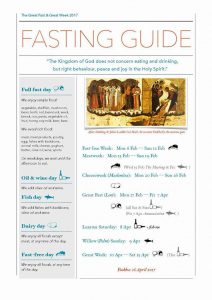
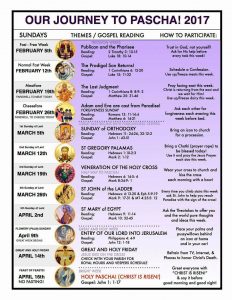
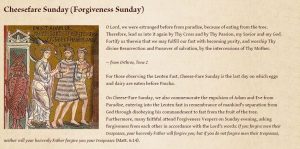
 Today, the Church calls this Sunday “Forgiveness Sunday” and you may also know it as Cheesefare Sunday. The Byzantine Church uses the image of Lady Lent to illustrate (especially to children) the meaning of Lent in an accessible way.
“For if you forgive other people when they sin against you, your heavenly Father will also forgive you. But if you do not forgive others their sins, your Father will not forgive your sins.” (Matthew 6:14-15)
The three pillars of the Great Fast are fasting, prayer and almsgiving. In the Great Fast, the idea is to increase one’s prayer, perhaps adding to morning and evening prayer, prayer at noon. Feeding the mind/soul is needed: book will be chosen for special spritual reading?
Likewise, virtue is extroverted. This past year the Universal Church under Pope Francis drew our attention to living the Works of Mercy, the 7 spiritual and 7 corporal works of mercy. All of them are based in sacred Scripture; read the Gospel of Matthew 25. During Great Lent, what work of mercy will we do to live a Work of Mercy?
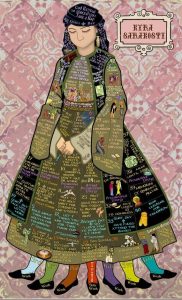
Lady Lent in your home?
The tradition is that before Lent starts, the family will make “Lady Lent” out of paper, clay or baked flour.
Lady Lent is made with no mouth as a sign of fasting. She has no ears, as she refuses to listen to gossip. Her eyes are closed, as she refused to watch and judge others. Her head is tilted, her eyes closed and her hands are folded reverently in prayer as a reminder of our spiritual journey during Lent.
She has seven feet, based on the number of Sundays until of Lent until Pascha. The tradition is that, every Saturday one of her feet is cut or broken off until she had no more feet by Holy Saturday, before Easter.
On Holy Saturday, the last foot is cut off and then is placed in a jar dried fruits and nuts, and whoever finds it receives a special blessing. Traditionally, whoever finds the last leg of Lady Lent, would right their his/her name and date on the back of it and keep it for good luck.
(h/t BC)
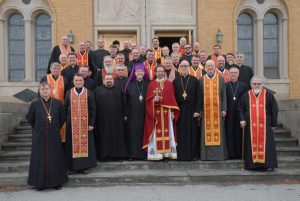 During the first week of the Great Fast clergy of the Stamford Eparchy attended their annual clergy retreat at Mt. Alvernia Retreat Center in Wappingers Falls, NY.
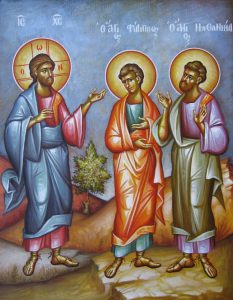 This Sunday is called the “Sunday of Orthodoxy” because it commemorates the restoration of the Church’s teaching on making images (icons) of our Lord and the saints in the year 843. Before that, it was the Sunday of the Commemoration of the Holy Prophets. This explains the Gospel, Phillip witnesses to Nathanael: “We have found him of whom Moses in the law and also the prophets, wrote – Jesus of Nazareth, the son of Joseph.” This is our goal in the Great Fast – to find our faith in Jesus. The Great Fast was the training period for those about to be baptized, and it was a time for the whole community to rediscover its faith. Along the journey to Holy Week, we read especially from the book of Genesis and from Isaiah to guide us to Christ, who will perfect his covenant with us by his death and resurrection. This is why, in the Apostolic reading, we remember Moses, Gideon, Barak, Samson, Jephthah, David and Samuel and all the prophets. It was all for Jesus, “Yet all these, though approved because of their faith, did not receive what had been promised. God had foreseen something better for us, so that without us they should not be made perfect. (Hebrews 11:39)”