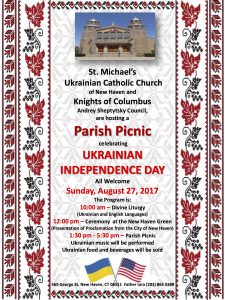
Sunday’s Liturgy and Parish picnic
There is one (1) Divine Liturgy, Sunday, August 27th at 10:00 a.m.
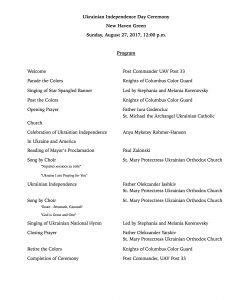
After the Liturgy there will be a brief ceremony on the New Haven Green honoring Ukrainian Independence Day.
At 12:30 p.m. we will have our parish picnic.
Parish Picnic 2017
JOIN US for the annual parish picnic on August 27th!!!
A whale of a time
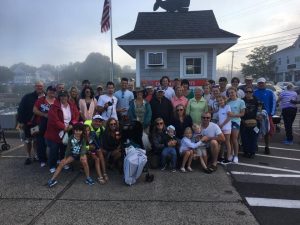
Some of the parish went on a Whale Watch ably organized by Carl Harvey today, in scenic Plymouth, MA. Lots of whales seen and appreciated. A great and beautiful experience.
Divine Liturgy for the coming week
Glory to Jesus Christ
Sunday, 8/20/17 11th Sunday after Pentecost
9:00 a.m. For people of the parish
10:30 a.m. God’s blessing and health for Anna Mazur requested by Stefanie Sisisky
Epistle: 1 Corinthians 9:2-12
Gospel: Matthew 18:2-35, Tone 2
Monday, 8/21/17 Holy Apostle Thaddeus and the Holy Martyr Bassa
8:00 a.m. no special intention for the Divine Liturgy
Tuesday, 8/22/17 Holy Martyr Agathonicus and companions
8:00 a.m. no special intention for the Divine Liturgy
Wednesday, 8/23/17 Holy Martyrs Luppus and Irenaeus, Bishop of Lyons
8:00 a.m. no special intention for the Divine Liturgy
Thursday, 8/24/17 Holy Priest-Martyr Eutyches
8:00 a.m. no special intention for the Divine Liturgy
Friday, 8/25/17 Holy Apostles Bartholomew and Titus
8:00 a.m. no special intention for the Divine Liturgy
Saturday, 8/26/17 Holy Martyrs Adrian and Natalia
9:00 a.m. no special intention for the Divine Liturgy
Sunday, 8/27/17 12th Sunday after Pentecost —Venerable Father Pimen
9:00 a.m. Special Intention
10:30 a.m. For the people of the parish
Epistle: 1 Corinthians 15: 1-11
Gospel: Matthew 19: 16-26, Tone 3
Parish announcements this week
Christ is in our midst!
1. WELCOME ALL NEW PARISHIONERS! New parishioners are always welcome in our parish. If someone wishes to join, please contact Father Iura Godenciuc at 203 865-0388 or our Financial Secretary Natalie Chermak at 203 468-0367.
2. AFTER DIVINE LITURGY: Dear parishioners and guests, after each Divine Liturgy, coffee and hard rolls are available in the church hall.
3. FOOD DRIVE: Judy Ellis leads the mercy project which provides food items to the needy. A container is in our church vestibule for non-perishable food. This collection will be taken every week. Father Iura will distribute the food to those in need. Thanks for your generous support.
4. ANNUAL STAMFORD CHARITIES APPEAL: REMINDER: Please don’t forget to donate for the Charities Appeal. Please make your check payable to the Diocese of Stamford. Please do NOT mail the form to the chancery office. We sincerely ask all parishioners to make generous contribution.
5. UKRAINIAN INDEPENDENCE DAY on August 24, 2017: Will be celebrated here this year on Sunday August 27, 2017. The Divine Liturgy will be celebrated at 10:00 a.m. A Proclamation Ceremony will take place on the New Haven Green by the flag pole at noon. The Annual Independence day picnic will commence at 1:00 p.m. at the Church Hall and Church garden. All are invited to attend. Saint Mary’s Ukrainian Orthodox Church will celebrate their Divine Liturgy at 10:00 a.m. and join us on the New Haven Green and at our picnic afterwards. The food served will be a selection of Traditional Ukrainian foods, drinks, soups and homemade desserts.. As well as some traditional American hot dogs, hamburgers and ice cream for the children.
6. The last meeting for the 50th CT State Ukrainian Day Festival will be held on Monday, August 28, 2017, beginning at 6:30 p.m. The meeting will be hosted by “The Protection of the Blessed Mary Ukrainian Catholic Church, 255 Barnum Avenue, Bridgeport, CT 06608.
7. VOLUNTEERS NEEDED; We are in the process of cleaning, painting and updating the interiors of the church hall and later the Church. Right now we would appreciate volunteers to help with cleaning and painting the walls and rooms in the church hall basement. Work crews are being scheduled. Please contact Father Iura with your availability. Your efforts (elbow equity) into this project will save the Parish significant amounts of money, improve the appearance of the buildings and go towards protecting our assets for future generations.
Dormition’s blessing of herbs and flowers
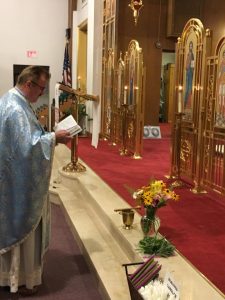 Tonight at the Divine Liturgy, Father Iura blessed herbs and flowers.
In giving birth you kept your virginity; in your Dormition you did not leave the world, O Mother of God, but were joined to the source of Life. You conceived the living God and, by your prayers, will deliver our souls from death. (Byzantine Liturgy; Troparion, Feast of the Dormition)
Dormition Liturgy today
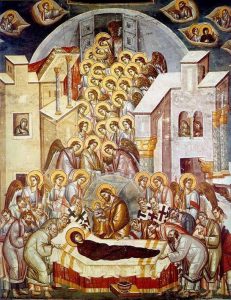
The Divine Liturgy will be served at 10:00 a.m. and at 7:00 p.m.
Bring herbs and flowers for a special blessing.
The Dormition of the Theotokos
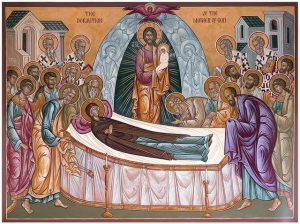 “Come, all you ends of the earth, let us praise the blessed passing of the Mother of God. She delivers her sinless soul into the hands of her Son; through her holy Dormition, the world is given new life.” (Stichera at the Litija)
The feast of the birth of John the Baptist is sometimes called the summer Christmas, so also the Dormition (falling-asleep) of the Mother of God might be called the summer Pascha. In both these feasts the cosmic change accomplished by the mystery of the Incarnation of the Son of God is seen in the lives of human beings, for in Christ the order of mortality is overturned. In the mystery of Mary’s falling-asleep, we see our sinfulness is over-written by the sinless one, who in obedience turns over her “sinless soul” to the incarnate God.
The Gospel today is a story not about Mary, the Theotokos, but about Mary of Bethany, but the words addressed by God to her sister Martha become iconic for all human beings: “Mary has chosen the better part and it will not be taken from her. (Luke 10:42)” What has she chosen? To sit at the feet of our Lord, to put Jesus at the center of her life, and to listen to him. This is Mary’s eternal mission, as she tells the stewards at the wedding in Cana: “Do whatever he (Jesus, her Son) tells you. (John 2:5)” This is the mystery the ends of the earth celebrate today, for it has transformed the meaning of human life, and “through he holy Dormition, the world is given new life.”
Meditation by Archpriest David Petras
St Maximus the Confessor
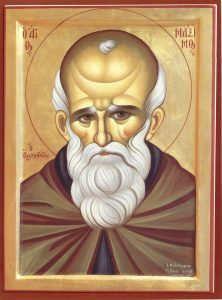 August 13 is the feast-day of St. Maximus. Because it is also the leave-taking of the Feast of the Transfiguration of our Lord, the liturgical commemoration is transferred to Saturday. Today Maximus is considered one of the “pillars of Orthodoxy,” and Fr. John Meyendorff called him “the father of Byzantine theology.” His accomplishments are many – he was martyred because of his faithful defense of the incarnation of our Lord, that he was truly human in every way (except sin) and had a human will. He had to live many years in exile.
[Maximus] has become much more respected in recent years, I think, because his theology has much to say to the modern world. His theology of deification calls us to see the world as more than “materialism,” only what we can see or hear or touch. He teaches us that there is more to our existence, a spiritual dimension that surpasses bodily passions and concerns. Reading Maximus, however, can be very difficult. He was committed to Greek literary and rhetorical styles, appearing in long. convoluted sentences. He also used the vocabulary of Neo-Platonism, which few can understand today. Many of his works have been translated into English, and his best are the Four Centuries on Love, his Commentary on the Our Father and his work on the Liturgy, The Church’s Mystagogy. All are found in the Paulist Press series “The Classics of Western Spirituality,”: Maximus Confessor: Selected Writings,” translated by George Berthold.
Today, we pray: “Taking its abode within your heart, the thrice-brilliant light made you a chosen vessel. It has revealed heavenly things in you, O blessed saint. You made deep and complicated ideas clear to us, and you preached the eternal Trinity to everyone, O Maximus.“ (Kontakion)
Meditation by Archpriest David Petras