 The Philip’s Fast (Pylypivka), the pre-Christmas fast, begins today. The Church begins the Fast the day after the feast of the Holy and All-Praiseworthy Apostle Philip. The Fast is a period of 40 days of spiritual preparation for the celebration of the Nativity/Theophany cycle of the liturgical (Church) year.
Historically, the Philip’s Fast (Pylypivka) was a period of strict fasting on Monday, Wednesday, and Friday –days of strict fasting without meat, dairy products or oil (in Slavic countries).
Now the bishops have indicated that the Fast is lessened a bit also to include fasting, works of penance and doing charitable work. BUT today we observe the Fast on Wednesdays and Fridays by an abstention from meat and foods that contain these ingredients.
The Ukrainian Greek Catholic Church teaches her faithful that “Penitential fasting practices, repentance and abstinence that aim to satisfy the sins committed and to achieve the highest level of perfection is the oldest tradition in the Ukrainian Greek Catholic Church” (CCEO: 882, § 1).
Recall, the Ukrainian Greek Catholic Church maintains that “Abstention from meat and meat products is to be observed on all Fridays of the year except for compact weeks, patronal feasts and the twelve major feasts” (CCEO: 882, § 4).
Definitions
Abstinence means that we do not eat a certain type of food, for example meat and oil, or any other foods that have that as an ingredient.
Fasting means that we eat less food. A general rule is that for a day of fast, the amount of food of the main meal is less than the other two meals combined.
Those exempt from fasting and abstinence are:
- Children under the age of 14
- Adults over the age of 60
- those who are gravely ill
- pregnant women
- post-partum mothers
- breast-feeding mothers
- travellers (if travel time exceeds 8 hours)
- those engaged in heavy labour
- those who eat from the table of others
- the poor who live from charity
On December 24, the Vigil of the Nativity, there is an abstention from meat, dairy and eggs, and foods that contain these ingredients.
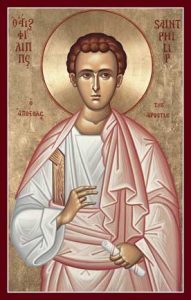 In today’s Gospel, Jesus calls Phillip, who immediately follows him. He then brings his friend Nathaniel to Jesus, “We have found the one about whom Moses wrote in the law, and also the prophets, Jesus son of Joseph, from Nazareth. (John 1:45)” This is the feast to begin our Christmas preparation. Phillip leads us to the one true Messiah, the child born of Mary in Bethlehem. The child “who, though he was in the form of God, did not rega
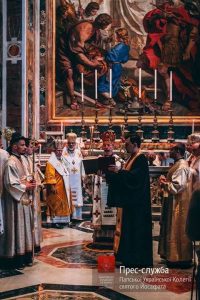 On Saturday, 11 November, there was a Divine Liturgy at St. Peter’s Basilica (Rome) over the tomb of St. Josaphat at the Altar of St. Basil the Great, as part of the festivities at St. Josaphat’s Pontifical Ukrainian College commemorating the 85th anniversary of its establishment and the Feast of St. Josaphat the College’s patron.rday, 11 November, there was a Divine Liturgy at St. Peter’s Basilica (Rome) over the tomb of St. Josaphat at the Altar of St. Basil the Great, as part of the festivities at St. Josaphat’s Pontifical Ukrainian College commemorating the 85th anniversary of its establishment and the Feast of St. Josaphat the College’s patron.
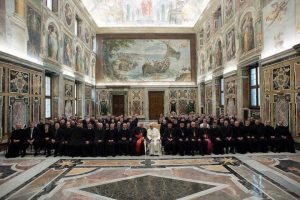 The Roman Pontiff, Pope Francis, welcomed the bishops, monks, priests and seminarians from St. Josaphat’s Seminary to celebrate the Seminary’s 85th anniversary.
 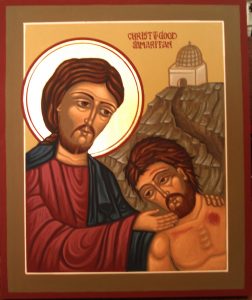 Ephesians 2:4-10; Luke 10:25-37
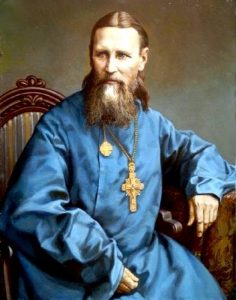 “Prayer is the lifting up of the mind and heart to God. From this it is evident that it is quite impossible for anyone to pray whose mind and heart are attached to anything carnal –for instance, to money or to honors –or who has in his heart passions such as hatred or envy for others, because passions usually contract the heart, in the same way as God expands it and gives it true freedom.”