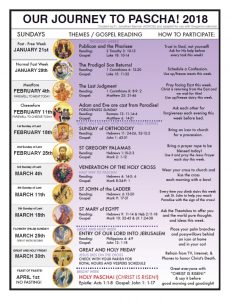
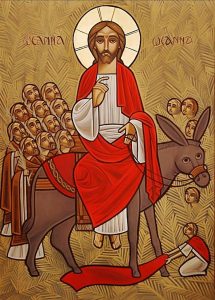
 As a preparation for Holy Week and Pascha, the Gospel of the passion of our Lord according to St. Mark is read. Today Jesus enters Jerusalem as the people exclaim, “Hosanna! Blessed is he who comes in the name of the Lord! Which we sing at every Liturgy in the Anaphora. These acclamations proved to be hollow, when the priests and elders seduced the mob to ask for Jesus’ crucifixion.
Here is a meditation of St. Gregory on the Passion:
So let us take our part in the Passover prescribed by the law, not in a literal way, but according to the teaching of the Gospel; not in an imperfect way, but perfectly; not only for a time, but eternally. Let us regard as our home the heavenly Jerusalem, not the earthly one; the city glorified by angels, not the one laid waste by armies. We are not required to sacrifice young bulls or rams, beasts with horns and hoofs that are more dead than alive and devoid of feeling; but instead, let us join the choirs of angels in offering God upon his heavenly altar a sacrifice of praise. We must now pass through the first veil and approach the second, turning our eyes toward the Holy of Holies. I will say more: we must sacrifice ourselves to God, each day and in everything we do, accepting all that happens to us for the sake of the Word, imitating his passion by our sufferings, and honoring his blood by shedding our own. We must be ready to be crucified. (St. Gregory the Theologian, Homily, 45)
Meditation by Archpriest David Petras
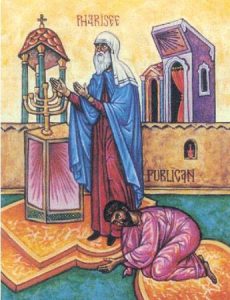
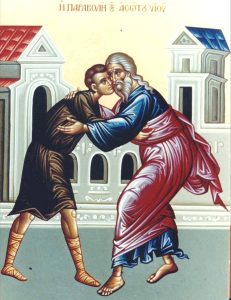 The parable read today is usually called “the parable of the Prodigal Son,” who is at the center of the story. It might also be called “the parable of the Merciful Father,” who welcomes back his son, embracing him, restoring him to his position, declaring a joyous celebration without even seeming to hear or listen to his son’s confession or protestation. It might also be called “the parable of the Petulant Son,” who is grumpy and peeved at the father’s merciful loving kindness because he thinks that he himself is so much better than his brother. As we prepare for the Great Fast, do we see a pattern developing? The pharisee thought he was much better than the tax-collector, the older son thought he was so much better than his prodigal brother, but God overflows in love for all his creatures. Perhaps the real main purpose of the Great Fast is to turn from pride to humility, to begin to see others through the eyes of God, to overflow in love for others. Truly, what does it mean to be a Christian?
 The journey of the feast of lights was a journey to specific holy places. It is a journey which we now make in spirit, in order to find the light of Christ. Soon after this journey, we begin another journey, going with our Lord to Jerusalem, as he foretold in the Gospel of St. Luke: “When the days for his being taken up (which John calls his glorification) were fulfilled, he resolutely determined to journey to Jerusalem.” During the Great Fast, then, we make another journey that ends in the holy city of Jerusalem, as Jesus said, “Yet I must continue on my way today, tomorrow, and the following day, for it is impossible that a prophet should die outside of Jerusalem” (Luke 13:33). But his death is his glorification, “by death he tramples death,” and it is the way to resurrection, to a resurrection promised to all. Our journey likewise ends in life (resurrection) and in light, as the Gospel of Paschal Sunday, the Day of Resurrection says, “ The light shines in the darkness, and the darkness has not overcome it” (John 1:5).