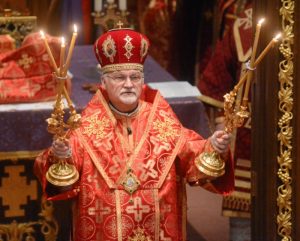
 Pope Francis accepts the resignation of Archbishop Stefan Soroka today, Monday, April 16, 2018, of the Archeparchy of Philadelphia of the Ukrainians (U.S.A.) and appointment of the Apostolic Administrator seat vacant of the same archeparchy.
The Holy Father accepted the resignation of the pastoral government of the archeparchy of Philadelphia of the Ukrainians (U.S.A.) presented by Archbishop Stefan Soroka.
At the same time, the Pope appointed as Apostolic Administrator vacant seat of the Philadelphia Archeparchy of the Ukrainians (U.S.A.) Bishop Andriy Rabiy, titular Bishop of Germaniciana, auxiliary of the same archeparchy. Bishop Rabiy was born in Lviv, Ukraine, on October 1, 1975.
Bishop Rabiy holds a bachelor’s degree in philosophy (1999) and a licentiate in Canon Law (2008) from Catholic University of America; and a Master of Divinity degree (2002), from the Dominican House of Studies, in Washington D.C.
After ordination, Rabiy held pastoral assignments at St. Michael the Archangel parish, Hillsborough, New Jersey, and at the Nativity of the Blessed Virgin Mary, New Brunswick, New Jersey, 2002-2005. Other assignments after ordination include: pastor of the Nativity of the Blessed Virgin Mary Ukrainian Catholic Parish in Reading, 2008-present; coordinator, Sexual Abuse Prevention and Youth Protection Office, 2008-2015; member, Administrative Board, Pennsylvania Catholic Conference, 2008-2017; vicar general, 2009-present; vice-chancellor, 2009-present; member, Archeparchial College of Consultors, 2009-present; member, Archeparchial Presbyteral Council, 2011-2017.
On August 8, 2017, Pope Francis named Father Andriy Rabiy as auxiliary bishop of the Ukrainian Catholic Archeparchy of Philadelphia.
Archbishop Stefan Soroka was born on November 13, 1951 in Winnipeg, Province of Manitoba, Canada. He received a bachelor’s degree in Social Work (1973) and a Masters in Social Work (1978) from the University of Manitoba. His seminary formation was undertaken at St. Josaphat Ukrainian Catholic Seminary, Washington, D.C. At the Catholic University of America, Washington, D.C., he earned a Bachelor of Sacred Theology (1978) and a Doctorate in Social Work in 1985.
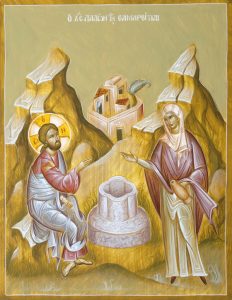 The theme of baptism continues in this Sunday’s Gospel, re-affirming that Pascha is a feast of resurrection and of baptism, being born into eternal life. The center of Jesus’ conversation with this unnamed woman (the Church later gave her the name Photine, the “enlightened woman”) is about water. They met at Jacob’s well, a place of great tradition, a sign and a promise of God’s love and mercy for his people. Jacob’s well provided the riches of water to a desert place, the sign that God would always provide for and bless his people. However, the encounter with the woman reveals something more: Jesus is the Messiah to come, he is greater than the Patriarch Jacob. The water of Jacob’s well is only for this world, Jesus would give “the water that would become a spring of water welling up to eternal life” (John 4:14). This clearly refers to our baptisms, as it comes immediately after the comparison of Jesus with John the Baptist, and the baptisms done by Jesus’ disciples. We renew our baptism every time we receive Communion, and they are for life, for eternal life, from God, the giver of life.
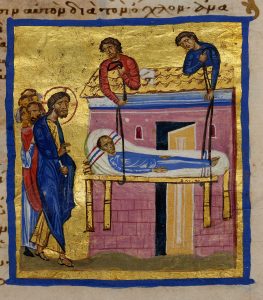 There are six Sundays in the forty day celebration of the Resurrection (corresponding to the forty days until the Ascension as recorded in the Gospel of Luke). The first three Sundays have a gospel of the Resurrection and the second three a gospel with a baptismal theme. Sadly, in our day the baptismal theme of the Feast of Pascha has sometimes been eclipsed, But Paul’s Letter to the Romans makes that connection: “Or are you unaware that we who were baptized into Christ Jesus were baptized into his death? We were indeed buried with him through baptism into death, so that, just as Christ was raised from the dead by the glory of the Father, we too might live in newness of life. (Romans 6:3-4)” This Sunday, we see this is the story of the Paralytic Man. He was without friends, paralyzed for thirty-eight years and unable to get into the pool when the angel touched the waters. However, he finds a friend in our Lord, who asks, “Do you want to be well?” This gospel affirms the sacramental mystery of baptism: it is not the water touched by an angel that cures the man, but the ultimate power of healing comes from the Lord, in the waters of baptism touched by the Holy Spirit sent by the Lord.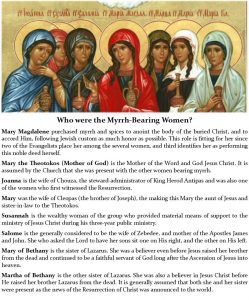
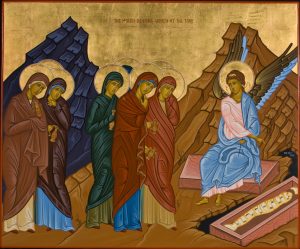 This Sunday presents us with the proclamation of the resurrection according to St. Mark.