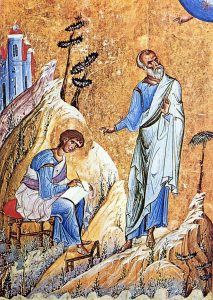
 [Today] On May 8, we celebrate one of the two feasts of the Holy Apostle and Evangelist John, the brother of James. The other is on September 26, the day of his falling asleep. The fourth Gospel is attributed to John, and we can truly call it a “theo-logical,” for it witnesses most clearly to the mystery of the Incarnation, of the Word of God taking flesh in the womb of the Holy Theotokos for our salvation. It is the most sublime Gospel, and it gave John the title “Theologian.”
The Byzantine Church have this gospel a certain priority, and it is read in the most joyful and glorious time of the year, from Pascha to Pentecost. This Gospel is the very essence of the apostolic witness, through which we come to faith in Christ, as indeed John foretold, when the risen Jesus says to Thomas, “Blessed are those who have not seen and have believed,” (John 20:29) because we have all heard of the divinity of the Lord through the witness of the apostles. Some try to discredit Christian faith by pointing out that John’s Gospel was the last to be written, that the first Gospel, Mark, does not mention the divinity of Jesus, and that faith in the Incarnation is then a later Christian development. They do this by trying to fit the Gospels into a linear line, from the earliest to the latest, and it is easy to fall for this.
However, the development of the Gospels in not linear, but they arise from different communities, and each has a vision of Christ. Indeed, does not St. Mathew’s Gospel proclaim the truth of the Trinity, where the risen Jesus proclaims, “Go, therefore, and make disciples of all nations, baptizing them in the name of the Father, and of the Son, and of the holy Spirit” (Matthew 28:19). And – yes – there are many other witnesses to Jesus’ divinity in the epistles and apostolic writings. The letter to the Hebrews says, “[Jesus] who is the refulgence of [the Father’s] glory, the very imprint of his being, and who sustains all things by his mighty word” (Hebrews 1:3). Rejoice, therefore, in this holy season in the glory of the risen Christ so beautifully proclaimed by John. It is John who tells us, “God is light, and in him there is no darkness at all. If we say, “We have fellowship with him,” while we continue to walk in darkness, we lie and do not act in truth. But if we walk in the light as he is in the light, then we have fellowship with one another, and the blood of his Son Jesus cleanses us from all sin” (1 John 1:5-7).
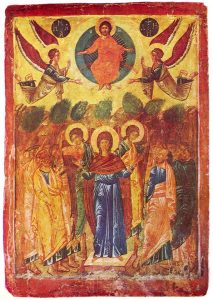 The ascension of our Lord into glory is the seal on his resurrection. Jesus taught Nicodemus, “No one has gone up to heaven except the one who has come down from heaven, the Son of Man” (John 3:13). St. Paul further explains that the ascension is the sign of his victory over the Hades, the kingdom of death, “What does ‘he ascended’ mean except that he also descended into the lower regions of the earth? The one who descended is also the one who ascended far above all the heavens, that he might fill all things” (Ephesians 4:9-10).
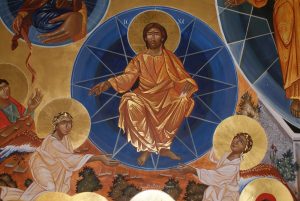 “…He ascended into heaven and sits at the right hand of the Father.”
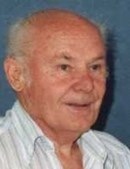 Peter Struk, 94, of North Haven, passed away peacefully on Thursday, May 3, 2018 at the MidState Medical Center, Meriden with his family by his side. He was the beloved husband of 70 years to Melanie Horn Struk. Peter was born on June 3, 1923 in Brzezany, Village of Litiatyn, Region of Galizien, Ukraine and was the son of the late Jacob and Chyma Slywka Struk. Peter was a member of the Carpenters Union Local #79, and worked as an installation technician for Atlantic Floor Covering in New Haven until his retirement. He was an avid gardener and a member of St. Michael’s Ukrainian Church for many years. Father of Peter H. (Victoria) Struk and the late Anna E. Struk. Grandfather of Peter A. and Sarah Struk.
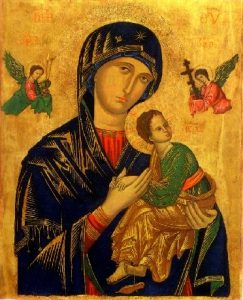 During the month of May our Ukrainian Greek Catholic Church honors the Mary the Mother of God in special prayer services as the akathist and moleben services. Mary was the humble servant of the Lord Who was always one with Her Son, our Lord God and Savior, Jesus Christ.
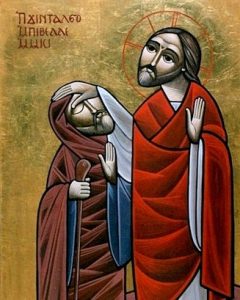 The story of the Man Born Blind is the third Sunday Gospel in Pascha about the mystery of baptism. This gospel is very clear, “Jesus spat on the ground and made clay with the saliva, and smeared the clay on his the blind man’s) eyes, and said to him, “Go wash in the Pool of Siloam” (which means Sent). So he went and washed, and came back able to see” (John 9:6-7). The clay represents the anointing we receive at baptism, making us “Anointed Ones,” (Christs, or Christians) and the washing represents the washing in the water of baptism. The blind man can then see, he is “enlightened,” the name the Church gives to baptism. Two observations: to be truly enlightened, we need humility.