 Read: 1 Corinthians 1:10-18; Matthew 14:14-22
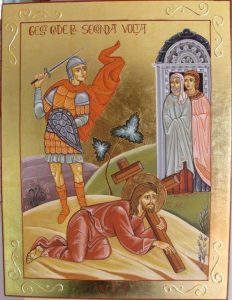
At the end of the reading of St. Paul’s letter to the Corinthians today, St. Paul says, “The message of the cross is foolishness to those who are perishing, but to us who are being saved it is the power of God.” We are asked to look toward the Holy Cross as the center of our Christian life. In the section of 1 Corinthians immediately the Sunday reading, St. Paul says, “For Jews demand signs and Greeks look for wisdom, but we proclaim Christ crucified, a stumbling block to Jews and foolishness to Gentiles, but to those who are called, Jews and Greeks alike, Christ the power of God and the wisdom of God. For the foolishness of God is wiser than human wisdom, and the weakness of God is stronger than human strength.”
The Christian faith is a paradox that finds strength in weakness, life in death and wisdom in foolishness. No wonder St. Paul observes today, “For Christ did not send me to baptize but to preach the gospel, and not with the wisdom of human eloquence, so that the cross of Christ might not be emptied of its meaning.” But what does the cross mean for our faith? Obviously, almost none of us will have to die as Christ did, nailed to a cross, though it is possible that some of us will have to surrender our lives for faith in Jesus. The gospel helps us to understand this. To carry the cross, we must put Jesus first in everything, as our Lord and Savior. It is he who feeds us with the bread of life in the desert of our lives. The multiplication of the loaves is a sign of the eucharist, of Christ giving himself to us, so that we might live in him and him alone. To accept the cross does not mean gratuitous suffering, but the will to live in Christ above all, to be so confirmed in faith that we would lay down our lives for him.
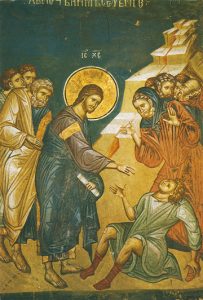
The power of the cross, therefore, is not in human eloquence but in the reality of a soul alive in Christ, as St. Paul again proclaimed, “For through the law I died to the law, that I might live for God. I have been crucified with Christ; yet I live, no longer I, but Christ lives in me; insofar as I now live in the flesh, I live by faith in the Son of God who has loved me and given himself up for me. (Galatians 2:19-20)” It means, as in today Gospel, imitating the Lord, who “saw the vast crowd, [and] his heart was moved with pity for them, and he cured their sick.” We, too, must love and care for each other, if not healing one another in body, than in spirit.
 Read: 1 Corinthians 4:9-16; Matthew 17:14-23
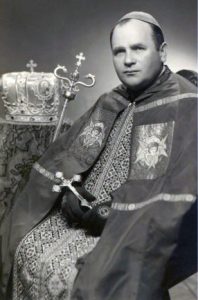 Basil or Vasiľ Hopko (April 24, 1904—July 23, 1976) was a priest and bishop of the Slovak Greek Catholic Church. He was beatified by Pope John Paul II for his martyrdom under Communist occupation.
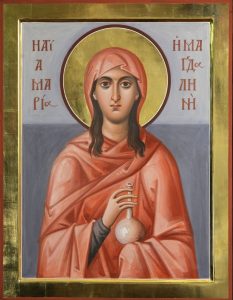 Today is the feast of St. Mary Magdalen
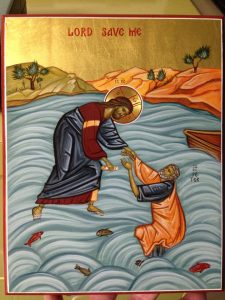 Read: 1 Corinthians 3:9-17; Matthew 14:22-34
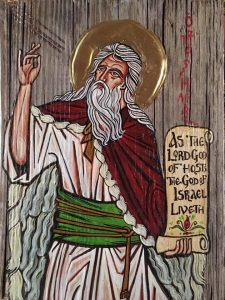 Today the Byzantine Church honors the memory of The Holy Great Prophet Elijah.
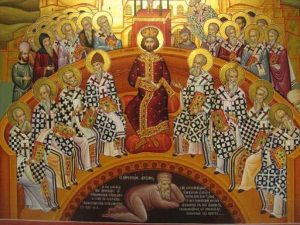 In addition to the observance of the 8th Sunday after Pentecost, the Church remembers the Father of the First 6 Ecumenical Councils. Moreover, the Church also liturgically recalls the memory of the Great Holy Prince, and Equal to the Apostles, Saint Vladimir.
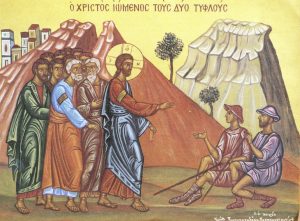 Read: Romans 15:1-7; Matthew 9:27-35