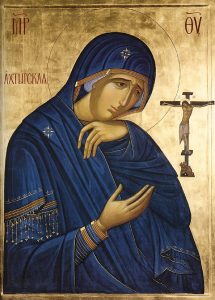
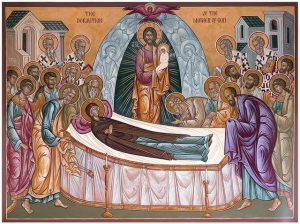
 “Come, all you ends of the earth, let us praise the blessed passing of the Mother of God. She delivers her sinless soul into the hands of her Son; through her holy Dormition, the world is given new life.” (Stichera at the Litija)
The feast of the birth of John the Baptist is sometimes called the summer Christmas, so also the Dormition (falling-asleep) of the Mother of God might be called the summer Pascha. In both these feasts the cosmic change accomplished by the mystery of the Incarnation of the Son of God is seen in the lives of human beings, for in Christ the order of mortality is overturned. In the mystery of Mary’s falling-asleep, we see our sinfulness is over-written by the sinless one, who in obedience turns over her “sinless soul” to the incarnate God.
The Gospel today is a story not about Mary, the Theotokos, but about Mary of Bethany, but the words addressed by God to her sister Martha become iconic for all human beings: “Mary has chosen the better part and it will not be taken from her. (Luke 10:42)” What has she chosen? To sit at the feet of our Lord, to put Jesus at the center of her life, and to listen to him. This is Mary’s eternal mission, as she tells the stewards at the wedding in Cana: “Do whatever he (Jesus, her Son) tells you. (John 2:5)” This is the mystery the ends of the earth celebrate today, for it has transformed the meaning of human life, and “through he holy Dormition, the world is given new life.”
Meditation by Archpriest David Petras
 Neither the tomb, nor death, could hold the Theotokos, who is constant in prayer and our firm hope in her intercessions. For being the Mother of Life, she was translated to life, by the One who dwelt in her virginal womb (Kontakion for the Dormition).
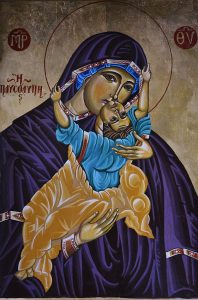 In addition to the myriad of feast days honoring Our Lady in her many titles and virtues, the entire month of May is especially given to her praise. In the words of Pope Paul VI: May is “a month which the piety of the faithful has long dedicated to Mary, the Mother of God . . . For this is the month during which Christians, in their churches and their homes, offer the Virgin Mother more fervent and loving acts of homage and veneration; and it is the month in which a greater abundance of God’s merciful gifts comes down to us from our Mother’s throne.”
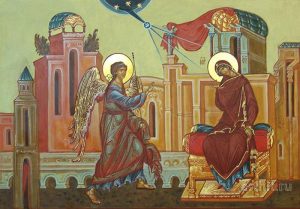 This weekend we are celebrating the mystery of our Lord’s accepting human nature for our salvation. The Archangel Gabriel asks Mary to receive God’s plan and become the mother of the Son and Word of God, to be named “Jesus,” “Savior.” Mary replies, “Behold, I am the handmaid of the Lord. May it be done to me according to your word. (Luke 1:38)” Mary’s response to God was perfect and reversed the sin of Eve. In our Lenten journey, we
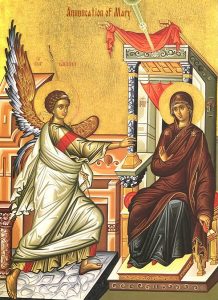 Annunciation of Mary, the Mother of God (Theotokos), March 25th
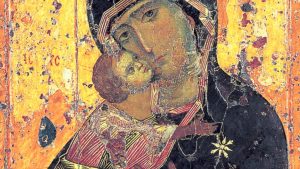 The following meditation opens an interesting question about Mary, the Mother of God (Theotokos means the bearer of God). A daughter of an Orthodox priest, Sister Vassa, a native of Nyack, NY, earned a doctorate in liturgical theology from the Pontifical Oriental Institute, Rome, now is a researcher and teacher in Vienna. She produces a the popular program, “Coffee with Sister Vassa.”
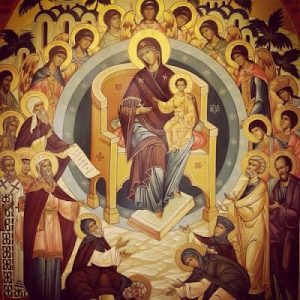 Today, the day after the Christmas feast the Byzantine Church honors Mary, the Mother of God (Theotokos) with a special feast day of remembrance.
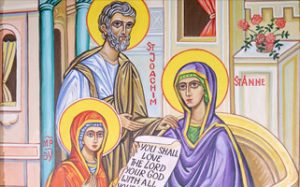 The Divine Liturgy will be offered on Thursday, December 8th at 9:00 a.m. for the feast of Conception of St Anne [also called the Maternity of Holy Anne].
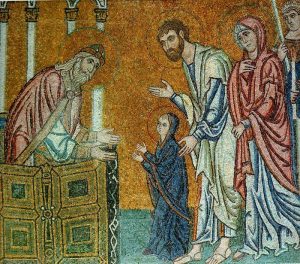 “The most pure Temple of the Savior; / the precious Chamber and Virgin; / the sacred Treasure of the glory of God, / is led today into the house of the Lord. / She brings with her the grace of the Spirit, / therefore, the angels of God praise her: / ‘Truly this woman is the abode of heaven.’” (Kontakion-Hymn of the Entry of the Theotokos into the Temple)